
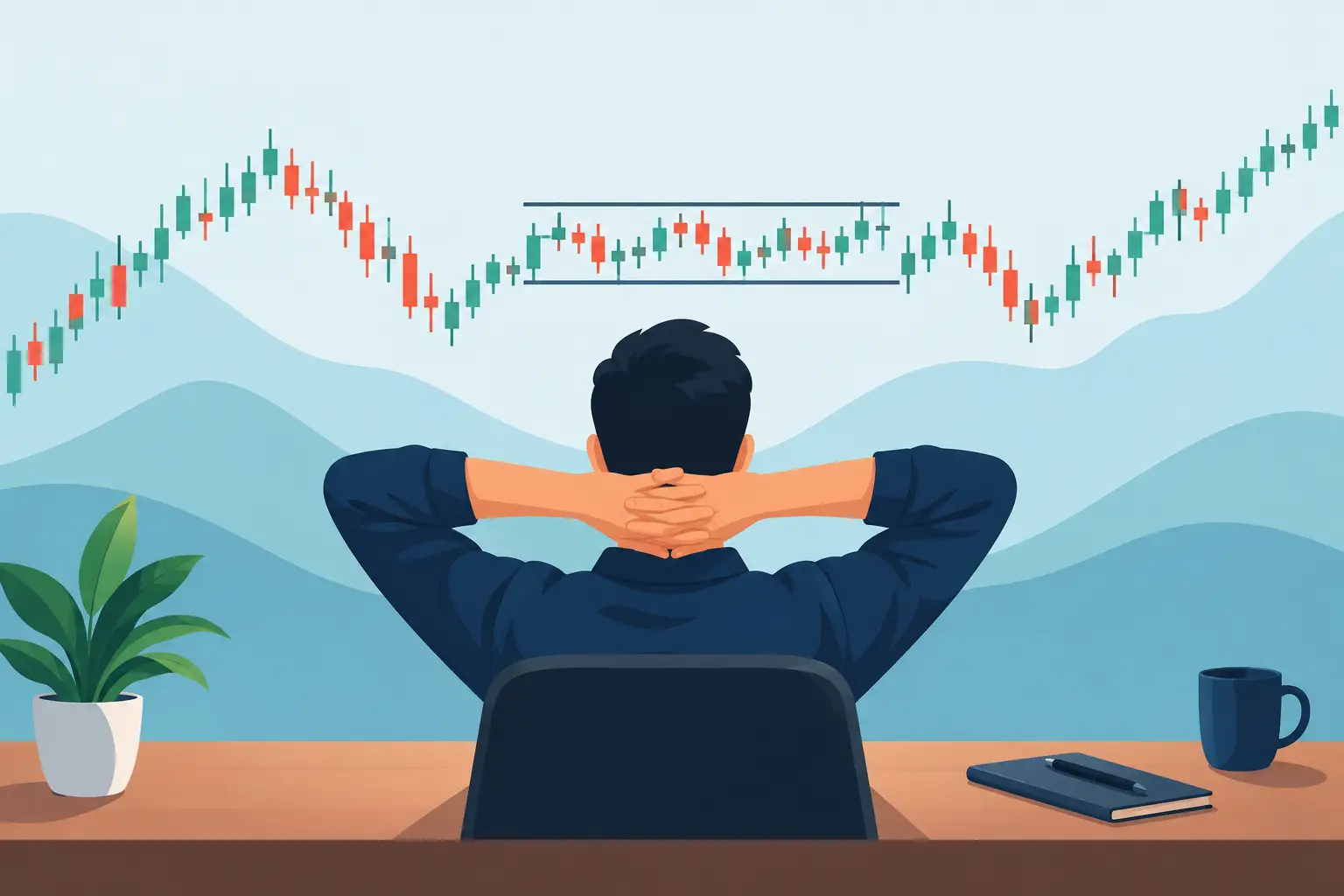
The most expensive trade is often the one you had no business taking. A Nasdaq futures chart can move fast enough to make inactivity feel like failure, especially after a quiet stretch. But when should traders stay flat? Whenever location, participation, and trade structure do not align, the correct decision is to protect the account and wait.
Flat is not passive. It is an active risk decision made before the market turns uncertainty into a loss. Professional execution is not about finding a reason to trade every session. It is about recognizing when auction conditions offer an edge and when they do not.
Staying Flat Is Part of the Trading Plan
Many traders treat a flat position as the absence of a plan. That thinking creates forced trades: entries in the middle of value, chases after an extended move, and attempts to predict a response before the market has shown one.
A better model starts with context before entry. Locate higher-timeframe value. Identify the meaningful auction levels. Then ask whether real participation is confirming the idea. If the answer is unclear, there is no trade to design.
Your job is not to capture every point. Your job is to take defined risk when the market gives you a defined opportunity. Staying flat preserves capital, mental bandwidth, and buying power for the moments that actually matter.
When Should Traders Stay Flat? Start With Location
Location determines whether a setup has room to work. A clean entry trigger in poor location is still a poor trade.
In the Middle of Value
The center of a balanced auction is where directional conviction often disappears. Price rotates, breaks briefly, returns, and punishes traders who mistake movement for initiative. If price is sitting between meaningful high-timeframe levels with no clear acceptance or rejection, you are likely trading noise.
This is especially dangerous for scalpers. A small target can look achievable until spread, slippage, and a quick rotational reversal consume the entire idea. Do not manufacture an edge inside the area where buyers and sellers are already in agreement.
Instead, wait for price to approach a value boundary, a prior high or low, a key liquidity area, or a level where the auction must make a decision. Location creates the possibility of asymmetric risk. The middle usually does not.
After an Extended Move Without a New Structure
A strong push can trigger the fear of missing out. Traders see momentum and enter late, just as the market reaches an area likely to pause, rebalance, or reverse.
Momentum alone is not an entry model. Ask what supports the next leg. Has price accepted above a key level? Is participation expanding? Has the market built structure that defines a logical stop and objective? If not, chasing is simply paying a premium for emotional relief.
There are times to trade continuation. But continuation requires more than a large candle or a fast tape. It requires evidence that the auction is still accepting higher or lower prices. Until that evidence appears, stay flat.
Stay Flat When Participation Does Not Confirm the Idea
Price can test a level without meaningful institutional participation. It can also appear to break a level only to reverse immediately once resting liquidity absorbs the move. This is why traders need more than a line on a chart.
A qualified trade connects location with participation. At a key level, look for initiative behavior, responsive behavior, absorption, acceptance, or rejection that makes sense for the trade thesis. If price is moving but order flow and momentum are conflicted, the market is not giving you a clean read.
For example, a breakout above a prior high is not automatically bullish. If price pokes above the level, participation fades, and it cannot hold acceptance, the better decision may be no trade until the failure or acceptance becomes clear. Prediction is optional. Confirmation is not.
This is where an auction-intelligence workflow earns its place. First Light Beacon is built around making value, key levels, and participation visible together so traders can stop treating isolated signals as a complete plan.
Avoid the First Move Around Major Scheduled Risk
Economic releases, central bank decisions, and major employment data can reset market value in seconds. The first move may be real. It may also be a liquidity sweep that exists only because the book thinned before the release.
Staying flat before scheduled news is not fear. It is a decision about whether your normal stop, target, and execution assumptions still apply. During a high-impact release, they often do not. Spreads can widen, fills can degrade, and a technically correct entry can become an oversized loss because the market moved through your stop before you could manage it.
The trade-off is obvious: you may miss a large directional move. That is acceptable. A large move is not automatically a tradable move for your account size or execution style.
Wait for the initial volatility to reveal a structure. Let price establish where it is accepting value, where it has rejected value, and whether participation supports continuation. Then build a trade with a real invalidation point. Bank like a pro by refusing to confuse volatility with opportunity.
Stay Flat After You Hit Your Daily Risk Limit
A daily loss limit only works if it ends the decision. Too many traders treat it as a suggestion, then try to win back the loss with smaller size, wider stops, or more trades. That is not discipline. It is loss-chasing in a different form.
Your maximum daily loss should reflect your account size, normal trade risk, and the number of attempts your model needs to prove itself wrong. Once that limit is reached, flat is mandatory. Do not negotiate with the rule because the next setup looks perfect.
The same principle applies after an unusually strong day. A trader who is up substantially can become careless, expand size, or give back gains in low-quality afternoon conditions. Locking down after reaching a daily objective is not weakness. It is recognizing that your decision quality can deteriorate when emotion changes.
Protect the account first. Tomorrow's opportunity is worth more than a revenge trade today.
Recognize Conditions That Create False Confidence
Some sessions look active but offer very little clean opportunity. Holiday trading, low-volume midday conditions, and overlapping headlines can produce erratic movement without reliable follow-through. The market may print enough candles to keep you engaged while offering no repeatable structure.
Be especially cautious when your usual setup appears repeatedly but fails to produce normal continuation. That is feedback. It may mean participation has changed, liquidity is thin, or the market is balancing in a way your setup does not handle well.
Do not force an old playbook onto a different auction. If the conditions that normally support your edge are absent, the edge is absent too. It is not you. It is the model telling you to stand down.
Use a Flat Filter Before Every Entry
The best time to decide whether you will stay flat is before you are emotionally attached to a trade. Build a simple gate into your execution process. Before clicking buy or sell, answer four questions:
- Is price at a meaningful location, rather than floating in the middle of value?
- Is participation confirming the direction or response I expect?
- Can I define entry, invalidation, target, and size before execution?
- Does this trade fit my daily risk rules and current market conditions?
If one answer is no, pause. If two answers are no, the decision is already made. Stay flat.
This filter is not designed to make you trade less for the sake of trading less. It is designed to eliminate guesswork. Some days it will lead to several trades. Other days it will lead to none. Both outcomes are valid if the process was followed.
Flat Is a Position, Not a Missed Opportunity
Futures traders are conditioned to believe activity creates progress. It does not. Clear information creates progress. A flat position keeps you available for the next high-quality auction location, protects your ability to execute without pressure, and prevents one poor read from becoming a damaged day.
The market will open again. Value will form again. Participation will reveal itself again. Trade with intention, wait for the conditions you can actually explain, and let patience be part of the edge you are paid to protect.