
Trading psychology is often described as a character test: be calmer, be tougher, follow the plan. That framing misses a practical systems question. If a risk rule exists only as a thought, what happens when the person enforcing it is also the person trying to win back a loss?
How can Trade Shield help with trading psychology?
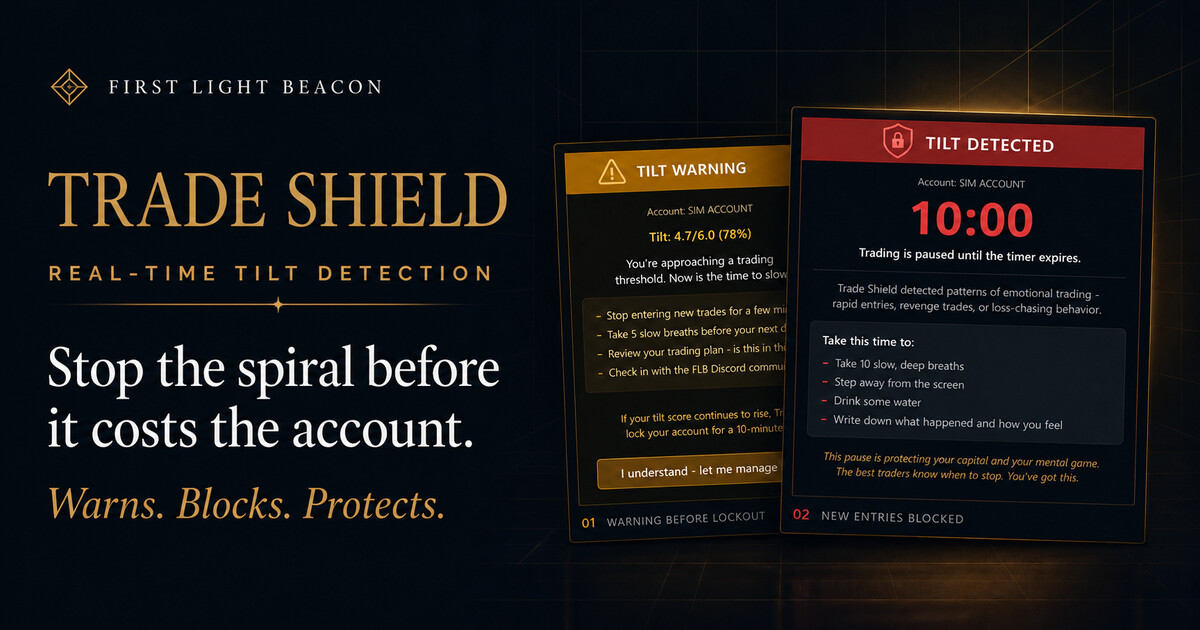
Trade Shield does not change a trader’s psychology or detect an emotion. It turns selected rules made before the session into local, account-level conditions and responses inside NinjaTrader 8.
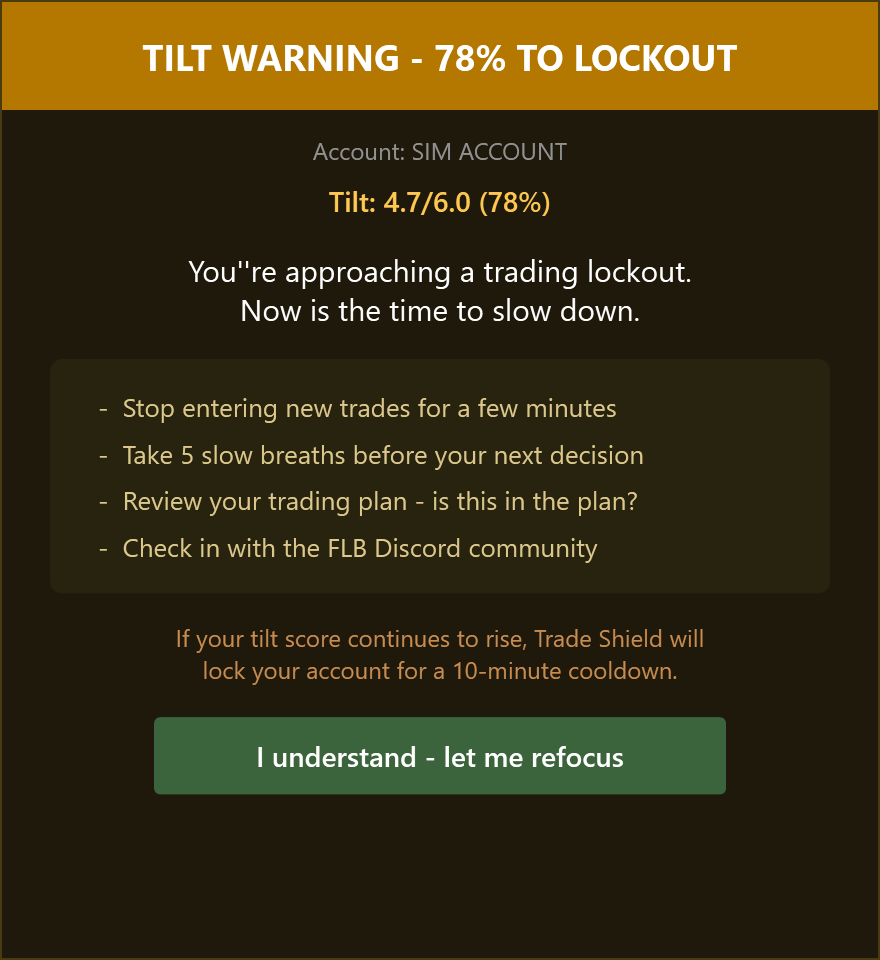
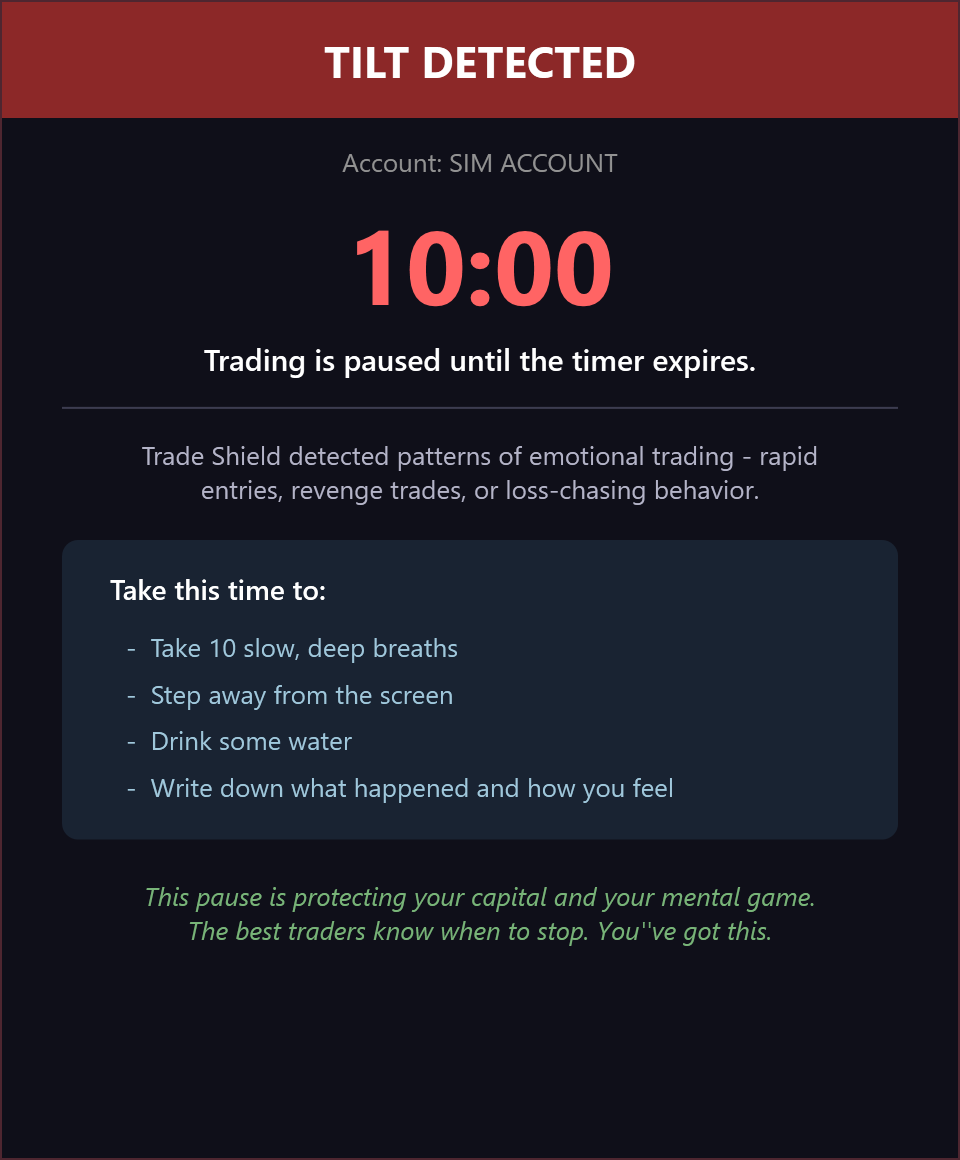
That can add friction between an impulse and new risk. Depending on the configured trigger, the product can warn, begin a cooldown, restrict new or added exposure, or use a defined lock or flatten response. Reductions and exits are designed to remain available.
This is pre-commitment, not prediction: the earlier version of you defines the boundary; software helps hold that boundary when observable trading activity reaches it. Trade Shield is still a local add-on. It cannot know intent, prevent every fill or loss, replace a protective stop, or guarantee better performance.
What behavioral-finance research actually shows
No study cited here tested Trade Shield, and several influential studies used retail stock accounts rather than leveraged futures. The findings should be treated as evidence of recurring decision patterns—not proof that every trader behaves the same way or that one tool fixes the problem.
Gains and losses are judged against a reference point
Kahneman and Tversky’s prospect theory models choices as changes relative to a reference point and treats gains and losses asymmetrically. It does not say that every loss causes reckless behavior, and it does not support the internet shorthand that a loss always hurts by one fixed multiple. It does explain why “getting back to even” can become psychologically different from making a fresh, plan-based decision.
Investors have held losers and realized winners at different rates
Terrance Odean analyzed 10,000 historical brokerage accounts and found that investors realized gains more readily than losses. The retained losers did not subsequently outperform the winners that were sold. This pattern is called the disposition effect. It is a population-level finding from stock accounts, not a verdict on any single position or futures trader.
Some professional traders increased risk after losses
In a study of Chicago Board of Trade proprietary traders, Joshua Coval and Tyler Shumway found that traders with morning losses regularly assumed above-average afternoon risk while trying to recover. Their execution was also poorer. This is one of the closest empirical parallels to what traders informally call revenge trading, but the paper did not use that label and should not be stretched into a universal rule.
More activity did not mean better net performance in one large sample
Barber and Odean studied 66,465 households and found that the households trading most earned materially lower net returns during the sample period. The data involved common stocks from 1991 through 1996, so it does not prove that a specific futures-trading frequency is excessive. It does challenge the idea that more decisions and more transactions automatically create more edge.
Emotion is relevant, but correlation is not destiny
A five-week clinical study of 80 day traders found that stronger emotional reactions to gains and losses were correlated with worse performance. The study was small and correlational; it does not establish that emotion caused the result. The useful takeaway is narrower: emotional response and trading performance can be related, so a process should not depend entirely on feeling neutral in real time.
Research boundary: loss aversion, the disposition effect, overconfidence, and post-loss risk are distinct concepts. They can overlap, but none is a clinical diagnosis and none lets software infer why a particular order was placed.
Revenge trading is a behavioral loop, not a sensor reading
Revenge trading is an informal term for abandoning a trading process in an effort to recover a recent loss. It can appear as an immediate re-entry, a lower-quality setup, larger size, faster trade cadence, or continued trading after the session’s stop condition. The order itself does not reveal the trader’s motive.
The focus shifts from executing the next valid setup to recovering the session P&L.
Waiting, setup quality, session boundaries, or planned size becomes negotiable.
Entries bunch together, size rises, or a daily stop is treated as a target to trade through.
The attempt to erase one result creates the conditions for another unplanned decision.
A journal can explain this loop after the session. A checklist can interrupt it if the trader chooses to stop. An account-level rule has a different job: respond to observable conditions while the sequence is happening. Those tools complement one another; they are not interchangeable.
Why pre-commitment can be stronger than one more reminder
Pre-commitment means voluntarily limiting a future choice before the tempting or pressured moment arrives. In trading, that might mean defining the session, maximum position, daily loss boundary, profit giveback, or post-loss pause before the market opens.
A laboratory asset-market experiment compared reminders with automatic stop-loss and take-gain devices. Automatic enforcement reduced the measured disposition effect; reminders did not. That study did not test Trade Shield, real-world futures execution, or a path to higher profits. It supports a limited systems principle: an enforced rule and a remembered intention are not the same mechanism.
The goal is not to automate confidence. It is to decide, while calm, which conditions should end or pause new risk—then make that decision harder to renegotiate after a loss.
The CFTC’s pre-trade checklist asks traders to identify their financial goals and the amount of risk and loss they can sustain. The NFA likewise emphasizes risk capital, temperament, and tolerance for risk. Neither regulator endorses Trade Shield; both reinforce the importance of defining limits before trading leveraged products.
Translate calm-state rules into observable guardrails
A useful rule must name something that the system can actually observe. “Do not get emotional” is not measurable. A session window, position ceiling, daily loss amount, elapsed time after a trigger, or sequence of account events is.
| Human-behavior risk | Rule defined before the session | Observable guardrail |
|---|---|---|
| Immediate recovery attempt after a loss | Pause new entries when the configured behavioral sequence reaches its trigger. | A warning or timed cooldown based on product-defined account-event patterns. |
| Increasing size to get back to even | Set the maximum account position before order entry begins. | A position ceiling that governs new or added exposure. |
| Trading beyond the planned loss | Define the daily financial boundary while P&L is neutral. | A configured daily-loss trigger and its specified response. |
| Giving back an unusually strong session | Choose in advance how much observed profit can be surrendered. | A configured goal, giveback, or profit-protection rule. |
| Late or off-plan participation | Define when new exposure is permitted. | A selected session window that restricts entries or additions outside it. |
The numbers should come from the trader’s risk plan, account constraints, and verified provider data—not from a software default or a desire to make the limit feel comfortable. Trade Shield does not determine what loss a trader can afford, whether a strategy has an edge, or whether futures trading is suitable.
What Trade Shield can—and cannot—do
Trade Shield runs locally in NinjaTrader 8 and evaluates account, order, execution, position, P&L, session, directional-state, configured-lock, and observable trading-sequence information that the connected environment exposes. It does not use a camera, biometrics, or AI to decide whether a trader is angry, afraid, or overconfident.
The local enforcement boundary
NinjaTrader documents that add-ons can receive account, order, execution, and position updates. That makes local governance possible, but it is not a broker- or exchange-side veto. A disallowed order may fill before a cancellation is confirmed; a corrective response can create another fill, with latency, slippage, commissions, and fees still possible.
- Trade Shield can respond only while Windows, NinjaTrader, the add-on, entitlement, connection, and relevant account-event stream are available.
- Activity placed elsewhere is observable only if the provider relays it into the same connected NinjaTrader account stream.
- Product labels such as tilt describe product-defined event patterns; they do not establish motive or mental state.
- Reductions and exits are designed to remain available, but connectivity and upstream systems can still affect an order.
- Trade Shield does not replace an appropriate protective stop, account supervision, provider controls, or a written risk plan.
- It cannot guarantee order prevention, fill price, loss containment, evaluation or payout results, profitability, or psychological change.
A calm-state simulation protocol
Behavioral guardrails should be tested as operational controls, not admired as settings. Use a simulation account first and write down the expected response before each scenario.
- Define the plan. Record the intended session, maximum position, daily loss, profit goal or giveback, and conditions for pausing new risk.
- Verify the data. Compare realized, unrealized, and combined P&L in Trade Shield with the NinjaTrader and provider values you trust.
- Test normal risk removal. Confirm that a reduction and full exit behave as expected while each restriction is active.
- Test each trigger separately. Create the expected warning, cooldown, financial lock, session restriction, and position-cap scenario without mixing causes.
- Test timing risk. Include a scenario where an order fills before cancellation and observe the corrective path, costs, and final position.
- Test restart and reconnect behavior. Reconfirm the intended account, current P&L, configuration, entitlement, lock state, and Protected/Ready status.
- Review the record. If observed behavior differs from the written expectation, resolve it before using live capital.
Simulation does not reproduce every live fill, latency condition, or emotional response. It is still the appropriate place to verify whether the local system behaves as documented in your actual platform and connection setup.
Trade Shield and trading psychology FAQ
What is revenge trading?
Revenge trading is an informal term for departing from a trading plan in an effort to recover a recent loss. It may involve rapid re-entry, weaker setup standards, larger size, or trading past a predefined stop condition. It is not a clinical diagnosis.
How can a trader reduce revenge trading?
Define objective limits before the session, use protective stops, journal the conditions that precede plan violations, and test an enforced pause or lock in simulation. No single control guarantees that revenge trading or further loss will be prevented.
Does Trade Shield detect emotions?
No. Trade Shield evaluates product-defined, observable account and trading-event patterns. It does not use a camera, biometrics, or AI to infer anger, fear, confidence, intent, or any mental state.
Can Trade Shield prevent overtrading?
Trade Shield can apply configured sessions, financial boundaries, position limits, warnings, and cooldowns to activity it can observe. Those guardrails may restrict some forms of unplanned activity, but the software cannot identify every definition of overtrading or guarantee prevention.
What is pre-commitment in trading?
Pre-commitment means defining a future boundary before pressure arrives, such as a session end, maximum position, daily loss, profit giveback, or required cooldown. An operational control makes that prior decision harder to renegotiate in the moment.
Does a daily loss limit guarantee the loss cannot grow?
No. Open risk, gaps, slippage, latency, partial fills, commissions, connection state, and orders that fill before cancellation can move the final result beyond a configured threshold.
Does Trade Shield replace protective stops?
No. A protective stop manages price-based risk for an open position. Trade Shield is a separate local account-governance layer. Every position still needs appropriate protection and responsible supervision.
Does Trade Shield work when NinjaTrader is closed or disconnected?
No. Trade Shield cannot observe or respond while NinjaTrader, Windows, the add-on, or the required account connection is unavailable.
Can software fix trading psychology or guarantee discipline?
No. Software can make selected rules operational and add friction before new risk, but it cannot change beliefs, create a profitable method, determine suitability, or guarantee disciplined behavior or trading results.
Sources and further reading
- Kahneman & Tversky (1979): Prospect Theory
- Odean (1998): Are Investors Reluctant to Realize Their Losses?
- Coval & Shumway (2005): Do Behavioral Biases Affect Prices?
- Barber & Odean (2000): Trading Is Hazardous to Your Wealth
- Lo, Repin & Steenbarger (2005): Fear and Greed in Financial Markets
- Fischbacher, Hoffmann & Schudy (2017): The Causal Effect of Stop-Loss and Take-Gain Orders on the Disposition Effect
- U.S. Commodity Futures Trading Commission: Checklist Before You Trade
- National Futures Association: Investor Best Practices
- NinjaTrader: AddOn access to account data and events
- NinjaTrader: Using third-party add-ons
- FLB Trade Shield product page
- FLB Trade Shield public guide
This guide was prepared by the First Light Beacon Product Team with AI-assisted research and drafting. Behavioral-finance claims were checked against the linked journal articles and regulator guidance. Trade Shield statements were checked against current public product documentation. The cited studies did not test Trade Shield and do not establish that it improves returns.
NinjaTrader is a registered trademark of NinjaTrader Group, LLC. First Light Beacon is not affiliated with or endorsed by NinjaTrader. Futures trading involves substantial risk and is not suitable for every investor. Use only risk capital and validate controls in simulation before live use.